Showing posts with label Auschwitz. Show all posts

Smartphone App for Oshpitzin/Oswiecim

A version of post also appears on my En Route blog for the Los Angeles Jewish Journal


By Ruth Ellen Gruber


The latest Jewish travel app for smartphones and tablets takes you to a place that no longer exists except in memory: Oshpitzin.

Oshpitzin was the Jewish name for Oswiecim, the small town in southern Poland where the Nazis built Auschwitz which had a majority Jewish population before the Holoc
aust -- I’ve written a lot about the town and its difficulty in balancing its Holocaust identity with its pre-WW2 past, starting in the mid 1990s, when I dealt with the issue in the long chapter “Snowbound in Auschwitz” in my book Upon the Doorposts of Thy House: Jewish Life in East-Central Europe, Yesterday and Today, which was a sort of diary and meditation on nearly four days blocked in Oswiecim by a freak snowfall…...

Last year, the Auschwitz Jewish Center—a prayer, study and research center in Oswiecim—launched a project aimed at putting Oshpitzin back on the map. It started with a printed guidebook and followed on withan interactive web site, www.ospitzin.pl, that includes a map, pictures, history, testimonies and more.

Now, the Center as followed through with a smartphone App that can be used by armchair travelers as well as actual visitors to the town. It has an interactive map, videos, audio, photographs, etc.

Most of the sites the project—be it the guide book, the web site or the App—describes no longer exist. But it all entails a way to learn about the Jewish history (and general history) of a town that existed for hundreds of years before “Auschwtiz” changed its identity from a place of Jewish life into a place of Jewish murder.

As of now, the App is available in the iTunes store for IPhone and IPad—but it will soon be available on Android, too.

Poland -- Concern over preservation of "forgotten" Holocaust sites

Gate at Auschwitz. Photo (c) Ruth Ellen Gruber

By Ruth Ellen Gruber

A fund-raising campaign for preservation of the infrastructure at Auschwitz has been achieving success. But focusing resources and attention on Auschwitz has raised concern that other Holocaust sites are crumbling. I wrote about this in a JTA article.

By Ruth Ellen Gruber  October 12, 2011 
ROME (JTA) -- Auschwitz, the most notorious camp in the Nazi killing machine, may soon claim success in its campaign to preserve the legacy of the Holocaust.

The foundation supporting the site in southern Poland has attracted tens of millions of dollars from donor countries, and the camp’s barracks and other buildings seem set to be preserved for decades to come. The museum memorial at the former Nazi death camp attracts more than 1 million visitors per year.

Some fear, however, that the concentration of resources and attention on Auschwitz could overshadow other preservation efforts and threaten the integrity or even the existence of the memorials and museums at lesser-known camps and Holocaust sites in Poland.

"Because Auschwitz is treated as the symbol of the Holocaust and the whole world is supporting only this museum, everybody in Poland, including the government, seems to think that this is enough," said historian Robert Kuwalek, a curator at the state-run Museum at Majdanek, the Nazi concentration camp and killing center near Lublin in eastern Poland. "The problem is deeper because it is the lack of basic knowledge that the Holocaust happened in forgotten sites like Belzec, Sobibor, Treblinka, Majdanek and Chelmno.”

Belzec, Sobibor and Treblinka were the three killing centers of the so-called Operation Reinhard plan to murder 2 million Polish Jews in 1942 and 1943. During that operation, Kuwalek said, "more people were killed in a shorter time than in Auschwitz-Birkenau during the whole period that that camp functioned."

Despite their importance in the history of the Holocaust, these and other sites -- such as the forced labor camps at Stuffhof and Gross-Rosen -- are overlooked by the vast majority of visitors who want to learn about the Holocaust or pay homage to its victims firsthand. All are marked by memorials or even museums. But some are located in remote parts of the country, and most are in serious need of upkeep and preservation.

The museum at Sobibor, for example -- the site of John Demjanjuk's crimes -- was forced to close in June when funding from local authorities ran out. An estimated 167,000 to 250,000 people, mostly Jews, were murdered at Sobibor, which is located in a remote part of eastern Poland. In May, a German court convicted Demjanjuk, now 91, of complicity in the murder of 28,000 Jews there.

"We simply realized that we could not afford to pay our bills this year, maintenance costs included," Marek Bem, a Sobibor museum spokesman, told the Krakow Post. "Without a stable budget we can't make any plans for the future."

The museum reopened July 1 after the Polish Culture Ministry announced that it would be reorganized as a state-run institution funded by the ministry.

"Auschwitz is the great exception to the rule," said Rabbi Andrew Baker, the director of international Jewish affairs for the American Jewish Committee. Baker was the point man for the AJC in its cooperation with the Polish government to build a large and impressive monument and museum at Belzec, where 500,000 Jews were killed. The center opened in 2004.

"With all the focus on Auschwitz, there's a kind of irony," he added. "It is coming that Auschwitz is becoming a universal symbol. It is raising money from scores of countries. When the survivors pass on, one question will be how to retain the identity of Auschwitz as a place where Jews were killed. It can become a universal place of lessons about genocide."

The Auschwitz Foundation was set up in 2009 with the goal of raising $163 million and thus guaranteeing an annual interest income of about $6 million for the much-needed conservation of barracks, the ruins of gas chambers, and other artifacts and material.

To date, nearly 20 countries have announced support for the effort, bringing the total pledges to more than $122 million. Germany alone pledged about $82 million. Israel was the latest country to pledge funds, with a $1 million contribution pledged to the foundation a few days before Rosh Hashanah.

In a statement quoted by the Auschwitz museum website, Yad Vashem director Avner Shalev explained why the investment was seen as so important.

"The site of Auschwitz-Birkenau, where over 1 million Jews were murdered during the Shoah, has become a key symbol of the Holocaust and of absolute evil," he said. "It is therefore a moral imperative to preserve the site's authenticity and legacy, and it is meaningful that Israel is participating in meeting that imperative."

The success to date of the Auschwitz fundraising campaign has been greeted with a cautious sigh of relief by scholars and preservationists who for years had raised the alarm about the threats to the site.

"It seems that the future of Auschwitz with regard to preservation is mostly secured," said Tomasz Kunciewicz, director of the Auschwitz Jewish Center, an educational institution in the town of Oswiecim, where Auschwitz is located. "Several governments have already made significant contributions, and others are expected to follow suit.

"However, regarding the more 'forgotten' death camps, such as Sobibor, the situation seems to be acute and there should be similar international efforts made regarding fundraising as in the case of Auschwitz."

In contrast to the 1.3 million visitors to Auschwitz last year, only about 30,000 go annually to Belzec, in southeastern Poland, and 20,000 visit Sobibor. Even Majdanek, which has a large museum and many more original buildings and other infrastructure than Auschwitz, attracts only about 100,000 annual visitors. The Majdanek museum is still coming to grips with a 2010 fire that destroyed one of the original barracks, where some of its key collections were stored.

"Everybody talks about the problems at Auschwitz," Kuwalek said. "Nobody pays attention to the other places. I'm really afraid that they were forgotten and will be forgotten."

Determining how to deal with these sites, he added, "will be a discussion that is more and more important. There is a recognition that something has to be done, but no one knows how and what."
Read the story at JTA HERE

Italy --Exhibition in Rome

By Ruth Ellen Gruber

What sounds like an interesting photographic exhibition opens tomorrow, Oct. 6, in Rome at the "House of Memoria and History". It's an exhibit of 300 photographs taken by Maurizio Agostinetto during a 960-kilometer trip by bicycle from the Brenner Pass to Auschwitz, retracing the route of 26 Jewish deportees during the Holocaust, including Primo Levi.

Poland: Oswiecim, the city of Auschwitz, wrestles with whether the past must be part of its future

My latest JTA story is about Oswiecim, the town outside of which Auschwitz was built.


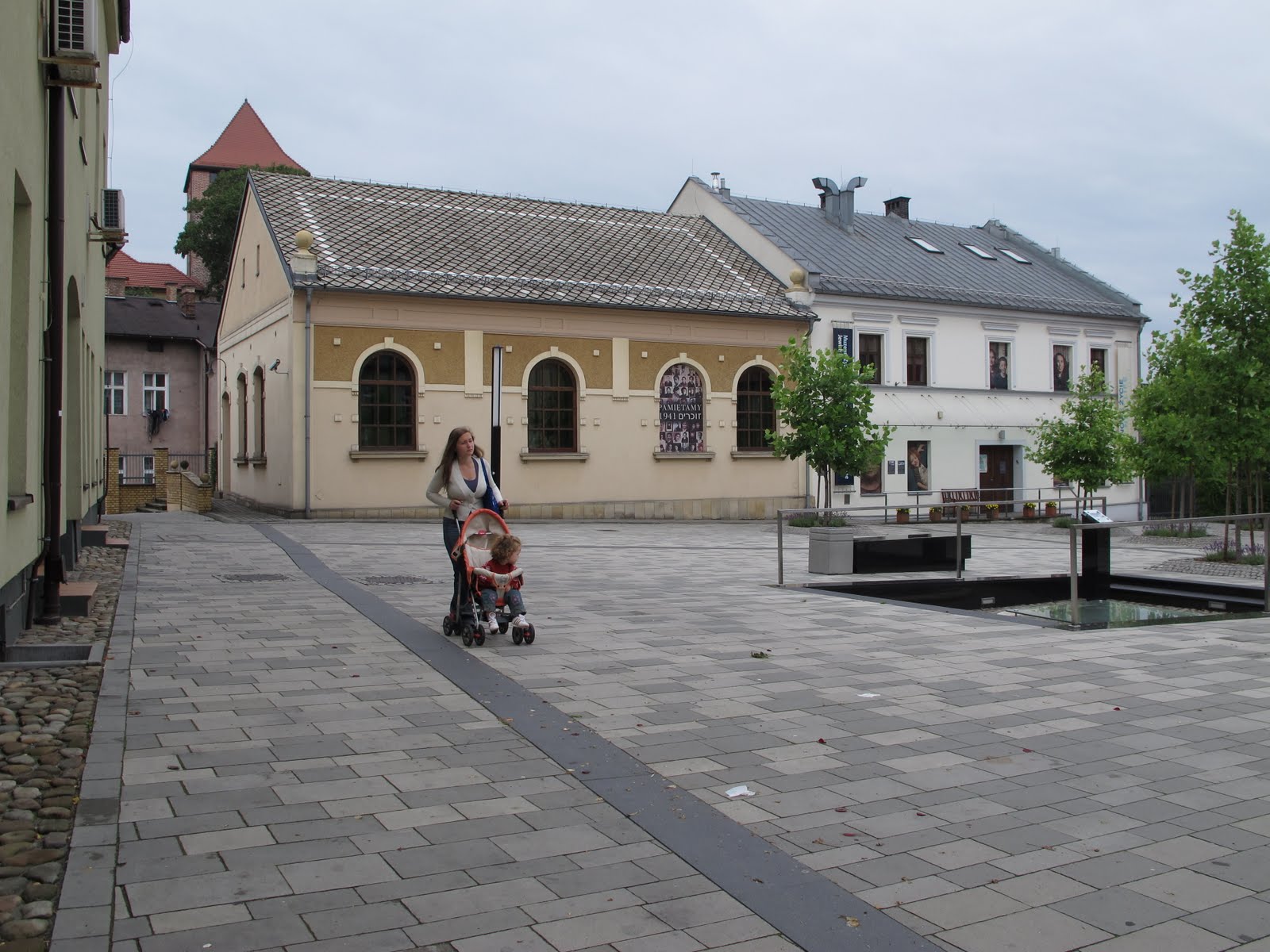
Woman walks her baby in front of the Auschwitz Jewish Center. Photo (c) Ruth Ellen Gruber


By Ruth Ellen Gruber

JTA, July 21, 2011

OSWIECIM, Poland (JTA) -- Can a town that exists in the shadow of death transform itself into a place of normalcy?

The question long has vexed Oswiecim, the town of 40,000 in southern Poland where the notorious Auschwitz death camp is located.

For decades, residents and city leaders have struggled to separate Oswiecim from Auschwitz and pull the town, its history and its cultural associations out from under the overwhelming black cloud of the death camp, which is now a memorial museum.

With only limited success to date, however, a new generation of town leaders is trying a different tack: bolstering Oswiecim as a vital local community, but also reaching out to connect with Auschwitz rather than disassociate from it.

"Ten or 15 years ago, many of us began thinking that the way to go was not to reject Auschwitz but to deal with it," said historian Artur Szyndler, 40, the director of research and education at the Auschwitz Jewish Center who grew up in Oswiecim under communism.

The town has adopted "City of Peace" as its official slogan. And for years a Catholic-run Dialogue and Prayer Center and a German-run International Youth Center near the camp have promoted reflection and reconciliation.

Downtown, the 10-year-old Auschwitz Jewish Center makes clear that before the Holocaust, Oswiecim had a majority Jewish population and was known widely by its Yiddish name, Oshpitzin. The center includes a Jewish museum and a functioning refurbished synagogue -- the only one in the city to survive. It runs study programs and serves as a meeting place for visiting groups.

And now the Oswiecim Life Festival, founded last year by Darek Maciborek, a nationally known radio DJ who was born and lives in Oswiecim, aims to use music and youth culture to fight anti-Semitism and racism.

"This place seems to be perfectly fitting for initiatives with a message of peace," Maciborek said. "A strong voice from this place is crucial."

The closing concert of this year's festival, held in June, included the Chasidic reggae star Matisyahu. He gave a midnight performance for a crowd of 10,000 in a rainswept stadium just a couple of miles from the notorious "Arbeit Macht Frei" ("work sets you free") gate of the death camp.

"It was an incredibly symbolic moment," Oswiecim City Council President Piotr Hertig told JTA. "It was a very important symbol that a religious Jew was performing at a festival in such a place."

Hertig said the new push to bolster Oswiecim and reach out more to the Auschwitz museum and its visitors is partly due to a generational shift in the town.

For a long time, most of Oswiecim's population consisted of thousands of newcomers from elsewhere in Poland who settled here after World War II. But today's community leaders increasingly include 30- and 40-somethings like Hertig and Maciberok who were born in Oswiecim and feel rooted here.

The town now has plans to go ahead with several projects that had been thwarted by outgoing Mayor Janusz Marszalek, who had particularly strained relations with the Auschwitz Memorial, according to Hertig. These include a new visitors' center for the memorial and a park on the riverbank just opposite Auschwitz that will be connected to the camp memorial by a foot bridge.

"This will be a very good place for people to come after visiting Auschwitz and Birkenau, where they can meditate, reflect and soothe their negative emotions," Hertig said.

Hertig said he hoped new programs and study visits developed with the Auschwitz memorial will encourage longer stays by visitors. Plans are in the works to build an upscale hotel in town and refurbish the main market square and other infrastructure.

"Auschwitz, on our outskirts, is the symbol of the greatest evil," Hertig said. "But at the same time we want to show to others that Oswiecim is a town with an 800-year history that wants to be a normal living town."

Located on the opposite side of the Sola River from the Auschwitz camp, Oswiecim has an old town center with a pleasant market square, several imposing churches, and a medieval castle and tower. In the modern part of town is a new shopping mall and state-of-the-art public library, as well as a big civic culture center that hosts a variety of events, including an annual Miss Oswiecim beauty pageant.

But few of the more than 1.2 million people who visit the Auschwitz camp each year ever set foot in Oswiecim or even know that the town exists.

"It is difficult to comprehend what it must be like to call this city your hometown," said Jody Manning, a doctoral student at Clark University in Worcester, Mass., who is writing a dissertation on life in Oswiecim and Dachau, Germany, also the site of a concentration camp.

Local residents long have resented that most outsiders make no distinction between their town and the death camp.

"People from outside are sometimes shocked. They ask how I can live in Auschwitz. But I don't -- I live in Oswiecim," said Gosia, a 30-year-old woman who works at the Catholic Dialogue Center. "This is Oswiecim, my hometown -- not Auschwitz!"

It remains to be seen whether the new push can help remove the stigma from Oswiecim and achieve a less strained modus vivendi with the death camp memorial. "People have the right to live normally, but I don't think they'll be able to disassociate from Auschwitz," said Stanislaw Krajewski, a leading Polish Jewish intellectual. "The best they can do is to use it in a constructive way; the very name Auschwitz has a magical power."

Poland -- New project on pre-WW2 Oshpitzin (Auschwitz)


By Ruth Ellen Gruber

The Auschwitz Jewish Center is launching on April 28 a new guide to pre-World War II Oshpitzin -- AKA Oswiecim, AKA Auschwitz.  The town had a majority Jewish population before World War II, and the project include an online map and hard-copy guide to the town's Jewish history and heritage.

The Auschwitz Jewish Center, opened in 2000, occupies a complex including the only surviving synagogue in Oswiecim and hosts a Jewish museum and education programs.

Poland -- Danny Ghitis' photos of Oswiecim

A cozy cafe in Oswiecim. Photo (c) Ruth Ellen Gruber

By Ruth Ellen Gruber

Danny Ghitis is a talented young photographer who has taken a great series of pictures about Oswiecim -- the living town in southern Poland outside of which is the infamous Auschwitz death camp. I'm delighted to see that a selection of them is featured on NPR. Before World War II, most of the residents of Oswiecim were Jewish.
Many tourists come in buses to Auschwitz for the day and may not notice the people who live in the surrounding towns. "Those who do notice," Danny Ghitis writes on his website, "a nearby shopping mall, high school sweethearts holding hands, nicely dressed families are headed to church — are faced with an impossible question: How can life exist in the aftermath of such overwhelming evil?"

Ghitis, Brooklyn-based photographer and grandson of a holocaust survivor, was plagued by that question, and spent some time in 2010 exploring the psyche of Oswiecim — as well as his own. "I was aware of my own strong biases," he writes in an e-mail, "but as a journalist I knew the reality of this town had to be more complex than is often painted."

Years ago, I wrote a long, long essay about being snowbound for three days iat Auschwitz and exploring the town of Oswiecim and how the looming shadow of the death camp affected the town -- it formed the final chapter of my book Upon the Doorposts of Thy House: Jewish Life in East-Central Europe, Yesterday and Today. The book is out of print -- but it's still a good read!

Poland -- Changes and modernization coming at Auschwitz Museum

By Ruth Ellen Gruber

The New York Times runs a long story on plans for change at the main exhibit at the Auschwitz memorial museum, from memorializing to teaching. These changes are long overdue. For teenagers, the Holocaust is ancient history: as the article point out, there are kids today visiting Auschwitz whose grandparents were born after WW2. Visitors need to learn from what they see as well as learn about what happened.
Now those in charge of passing along the legacy of this camp insist that Auschwitz needs an update. Its story needs to be retold, in a different way for a different age.
Partly the change has to do with the simple passage of time, refurbishing an aging display. Partly it’s about the pressures of tourism, and partly about the changing of generations. What is the most visited site and the biggest cemetery in Poland for Jews and non-Jews alike, needs to explain itself better, officials here contend.
A proposed new exhibition at the Auschwitz-Birkenau State Museum here, occupying some of the same barracks or blocks, will retain the piled hair and other remains, which by now have become icons, as inextricable from Auschwitz as the crematoria and railway tracks. But the display will start with an explanatory section on how the camp worked, as a German Nazi bureaucratic institution, a topic now largely absent from the present exhibition, which was devised by survivors during the 1950s.


The Auschwitz museum/memorial was founded in 1947, and throughout the communist period made scant note of the fact that the overwhelming majority of victims there were Jewish -- I can't remember, but I doubt if homosexuals or Roma were even mentioned. Changes came of course after the fall of communism: information panels were added, misleading captions and other information was rectified, a new official guidebook was published, and the "pavilions" dedicated to individual countries were thoroughly revamped. But the exhibition itself remained largely the same.

It is important to point out, too (the New York Times story omits this) that for the past 10 year the Auschwitz Jewish Center has functioned in the city of Oswiecim (outside of which the Auschwitz camp was built). It is located in the sole surviving synagogue in the town -- which before WW2 had a majority Jewish population. The synagogue is a functioning house of worship, and the complex includes a study and research center as well as a permanent exhibit about pre-war Jewish life in Oswiecim.

Auschwitz -- US Pledges Aid to Restore Camp

 Photo (c) Ruth Ellen Gruber

On Saturday, U.S. secretary of state Hillary Clinton visited the brand new Schindler's Factory Museum in Krakow -- a branch of the city's history museum dedicated to the period of Nazi German occupation in World War II. During her visit she announced U.S. plans to pledge $15 million over five years to help restore and maintain the former Nazi death camp at Auschwitz-Birkenau, not far from Krakow. The site was made into a memorial/museum after World War II but has suffered considerable deterioration over the years. Flooding this year forced it to be closed to the public.

Below is the US government statement. For a full text of Clinton's speech click HERE


Auschwitz-Birkenau Foundation Announcement


Office of the Spokesman
Washington, DC
July 3, 2010


In a speech today, July 3, at the Schindler Factory Museum in Krakow, Poland, Secretary of State Hillary Rodham Clinton announced the U.S. intention to contribute $15 million over five years to the Auschwitz-Birkenau Foundation, subject to Congressional authorization and appropriations. The World War II-era factory of Oskar Schindler, the German entrepreneur who saved hundreds of Jewish factory workers from the Holocaust and, Krakow, the closest major city to the camp and an important center of Jewish life before WWII, provide a meaningful setting for the U.S. announcement. The Secretary’s announcement of the anticipated U.S. contribution illustrates the significance of the Auschwitz-Birkenau site, helps commemorate the 1.1 million victims who perished there, and demonstrates America’s commitment to Holocaust education, remembrance, and research.

U.S. Contribution

*Subject to Congressional authorization and appropriations, the United States’ contribution of $15 million over five years will begin in FY 2012.

*The U.S. contribution will help fund a €120 million endowment to preserve and safeguard the remains of the camp. Due to the temporary nature of the camp’s initial construction, the buildings and other artifacts at Auschwitz-Birkenau are in poor condition and in serious danger of irreversible deterioration.

*The United States strongly encourages other nations who have not already done so to follow suit and to contribute to the Auschwitz-Birkenau fund to preserve the site for future generations.

Importance of Auschwitz-Birkenau

*The Auschwitz-Birkenau death and concentration camp is one of the most widely recognized symbols of racism, bigotry, and hatred where untold millions suffered unthinkable and heinous treatment under Nazi tyranny. While there are hundreds of other historically important camps and mass grave sites, Auschwitz-Birkenau has become a symbol of the Holocaust.

*In 2009 alone, more than 1.3 million people from around the world visited the museum and memorial, among them survivors of Nazi persecution and their descendents, students, educators, and many who only for the first time learned of the horrors that went on at this infamous camp.

*The preservation and continuation of Auschwitz-Birkenau is essential so that future generations can visit and understand how the world can never again allow a place of such hatred and persecution to exist. It is also an important educational tool to show those who doubt that the Holocaust ever existed that indeed, tragically, it did.

Germany and Poland -- Fire (Worms) and Flood (Auschwitz)

There has been an arson attack on the historic (rebuilt) synagogue in Worms, Germany, apparently by pro-Palestinian protesters who took out their anger at Israel by attacking a synagogue that had been built in the 11th century, destroyed by the Nazis, and totally rebuilt from the rubble and reconsecrated in 1961. It forms part of  a museum complex -- including the "Rashi House" Museum -- but also is used at times for services. The great 11th century Jewish scholar Rashi studied here, and the old Jewish cemetery in Worms is the oldest suriving in Europe, aside from the Jewish catacombs in Rome.

Reports said fires were set Sunday night at eight spots around the synagogue, but the fire department acted quickly and there was no serious damage. Police were reported to have found at the scene eight copies of a letter  that read, "Until you give the Palestinians peace, we will not give you peace."

Meanwhile, severe rains and flooding in southern Poland forced the closure of the Auschwitz Museum and Memorial at the former Nazi death camp and threatened the camp's archives.

Poland -- Link to an Auschwitz article....

At Auschwitz, July 2009. Photo (c) Ruth Ellen Gruber


I'm linking to an article, A "New Jew" Goes to Auschwitz, by Jay Michaelson, in The Forward, that provides an interesting take on how the Holocaust and Auschwitz (as a real place and as a symbol) are regarded by young generations for whom it is all increasingly distant history. (For someone in his or her 20s, it is more or less like World War One or the Edwardian Age is to my generation!) The article is subtitled "The Cathedral of Holocaustism."

Like many of my generation’s so-called “New Jews,” I see the recourse to the Holocaust as a substitute for living Judaism: an ersatz religion whose frisson of spiritual passion ultimately provides only negative reasons to live a Jewish life. As an activist, I am also dubious of how unspeakable tragedy was so readily converted into a platform for pretension, posturing and political exploitation. And as a teacher and writer, I know how easy it is to use the Holocaust as the ultimate cheap shot: the surefire way to get kids’ attention, get your book published and score points for piety when all else fails.

This summer, though, I visited Auschwitz for the first time. No, I was not in the parade of Jewish tourists on the European genocide trail, but since I was studying in Krakow (which, I hasten to point out, is joyful, cultured, vibrant and colorful) for the summer, I felt it was important to go, and so one rainy Sunday I went. So what happens when a “New Jew” goes to Auschwitz? In fact, despite my expectations, the trip underscored rather than undermined my ambivalence.

Read full story

Inevitably, the way we view the past changes. The comments on this article are particularly interesting...

Poland -- Dark Tourism at Auschwitz

Gate at Auschwitz, July 09. Photo (c) Ruth Ellen Gruber


By Ruth Ellen Gruber

There's an academic field (or sub-discipline?) known as "Dark Tourism." The term -- as the web site of the Dark Tourism Forum puts it, is
a label first coined in the mid 1990’s by Professors John Lennon and Malcolm Foley of Glasgow Caledonian University, [and] is the act of travel and visitation to sites of death, disaster and the seemingly macabre. Lennon and Foley’s book ‘Dark Tourism: The Attraction of Death and Disaster’, first published in 2000, whilst not the first publication to address the subject area within academia, it was the first to systematically outline some of the issues and concerns associated with tourism, death and associated suffering.
The Forum cites as examples of Dark Tourism such varied places as the London Dungeon, the Killing Fields of Cambodia, Ground Zero in New York, the Sixth Floor in Dallas (from which President Kennedy was shot), Arlington National Cemetery in Washington DC -- and, of course, Auschwitz.

I guess a lot of the travel that I carry out, write about (and, OK, promote) to sites of Jewish heritage can seem to some observers to fall under this rubric -- afterall, I'm talking about often abandoned cemeteries, ruined synagogues and other relics of a civilization and people who were all but wiped off the map in a horribly brutal fashion....

I prefer to see visiting these places, however, as an affirmation -- and acknowledgement -- of life; of lives lived, of culture created, of richness and fullness over the centuries. Yes, destroyed: but, as my brother Sam once (more than once) put it, Jews did not sit around in Europe for hundreds of years just waiting to be killed....their lives, culture, religious traditions, creativity, contributed mightily to Europe as a whole, and visiting sites of Jewish heritage is a recognition of this fact -- as fact that was woefully ignored, suppressed, or diminished for decades.

Visiting specific Holocaust sites is, on the other hand, a pure example of Dark Tourism. Commemoration, memorial and recognition, too, of course. But at death camps and execution sites one remembers and responds to the death and disaster.

Last weekend, I took a friend to visit Auschwitz for the first time. He is an American musician who was on tour in central Europe, and the festival he played in southern Poland was the first time he had been to Poland. Auschwitz is located only an hour or so away from the festival site. My friend had one morning free after the gig, so I drove him up there.

He is not Jewish, but he was born just four years after the end of World War II, and he remembers from his childhood how heavily the legacy of the War and the Holocaust was felt -- even in America. He grew up with the images and the imagery: the Arbeit Macht Frei gate, the crematoria; the railway head at Birkenau where railcars of Jews were separated, to the left, to the right.

Even though we had very little time that morning, touring the site with him -- first Auschwitz I, where the museum exhibits are arranged in brick barracks, then the vast, empty field at Birkenau -- was a powerful and moving experience.

I have been to Auschwitz many times by now, and each time I go there I feel that I am stepping into a place that is sort of in a different dimension. Things get distorted: thoughts, feelings, time, sounds. Inside the perimeter, I often feel that nothing outside exists. Yet, on occasion, I have spent hours simply prowling around outside the camp, photographing the signage and everyday banalities that do exist there "in the real world." (Afterall, more than half a million people a year visit Auschwitz, so it's clear that there will be infrastructure such as parking lots, coffee shops, WCs, restaurants, hotels, and shops selling books and souvenirs.)

Photo (c) Ruth Ellen Gruber


This time, I mainly just walked with my friend. Seeing it all, a bit, through his eyes -- his first tangible encounter with the reality of Auschwitz -- as well as my own.

Photo (c) Ruth Ellen Gruber

The night before we went there, we sat talking with some of the members of the Czech band that my friend was touring with. The young drummer, David, suddenly volunteered that one of his grandmothers was a survivor of Auschwitz, and that her parents, his great-grandparents, had been murdered there.

Did he want to go with us? I asked him.

No, he had already been and didn't need to go back, he said. But, he told us, "say hello to my family...."

Photo (c) Ruth Ellen Gruber


P.S. For those visiting Auschwitz who want to see how Jews lived before the Holocaust, I recommend a visit to the Auschwitz Jewish Center in Oswiecim, the town outside which the death camp was built. Oswiecim's pre-war population was more than 50 percent Jewish -- it was known in Yiddish as Oshpitsin -- and the museum is located in the complex that includes the town's one surviving synagogue. The exhibit deals largely with local pre-war Jewish life, and the center has other resources, too.

Poland -- What to do with Auschwitz

Auschwitz Gate, 2005. Photo (c) Ruth Ellen Gruber

The directors of the museum/memorial at Auschwitz and the Polish government have issued urgent calls recently for aid to conserve the crumbling infrastructure of the most notorious Nazi death camp. Auschwitz attracts hundreds of thousands of visitors a year, but its buildings, exhibitions and archives are -- literally -- falling to pieces.

The National Post runs an article dealing with the architecture of Auschwitz and the architecture of tourism there. It is a interview with Robert Jan van Pelt, a professor at Ontario's University of Waterloo who has studied the architecture of the death camp, and particularly that of its cremetoria.

Given the lack of resources and the inevitable decay, Prof. van Pelt said one solution quickly emerges. What he says next is stripped of sentimentality but not of respect.

"Most people talk about the future of Auschwitz very emotionally without actually having any knowledge about it and without actually having any grasp of the incredibly contradictory nature of the site in terms of preservation and management.

"I say they should maybe allow Birkenau to be surrendered to nature - which does not mean putting condos on it but simply seal off the site and we allow nature to take over in a kind of symbolic gesture that humanity failed so terribly there that we now give it over to the cockroaches and grass and whatever. They haven't screwed up as badly as we have."

He adds an important caveat: It should not be done as long as there are survivors who may wish a return visit to the site. (He, himself, had a Jewish uncle who died in Auschwitz; he was named after him.)

"People will have to make choices... let us at least make a distinction between what is critical for us, what is important for us and what is merely significant.

"In Auschwitz they were restoring the sewer works of the camps not because it was the most important but because it was the only thing that was not contested.

"Because whatever you do in Auschwitz someone will say that you made the wrong choice."

Read Full Article